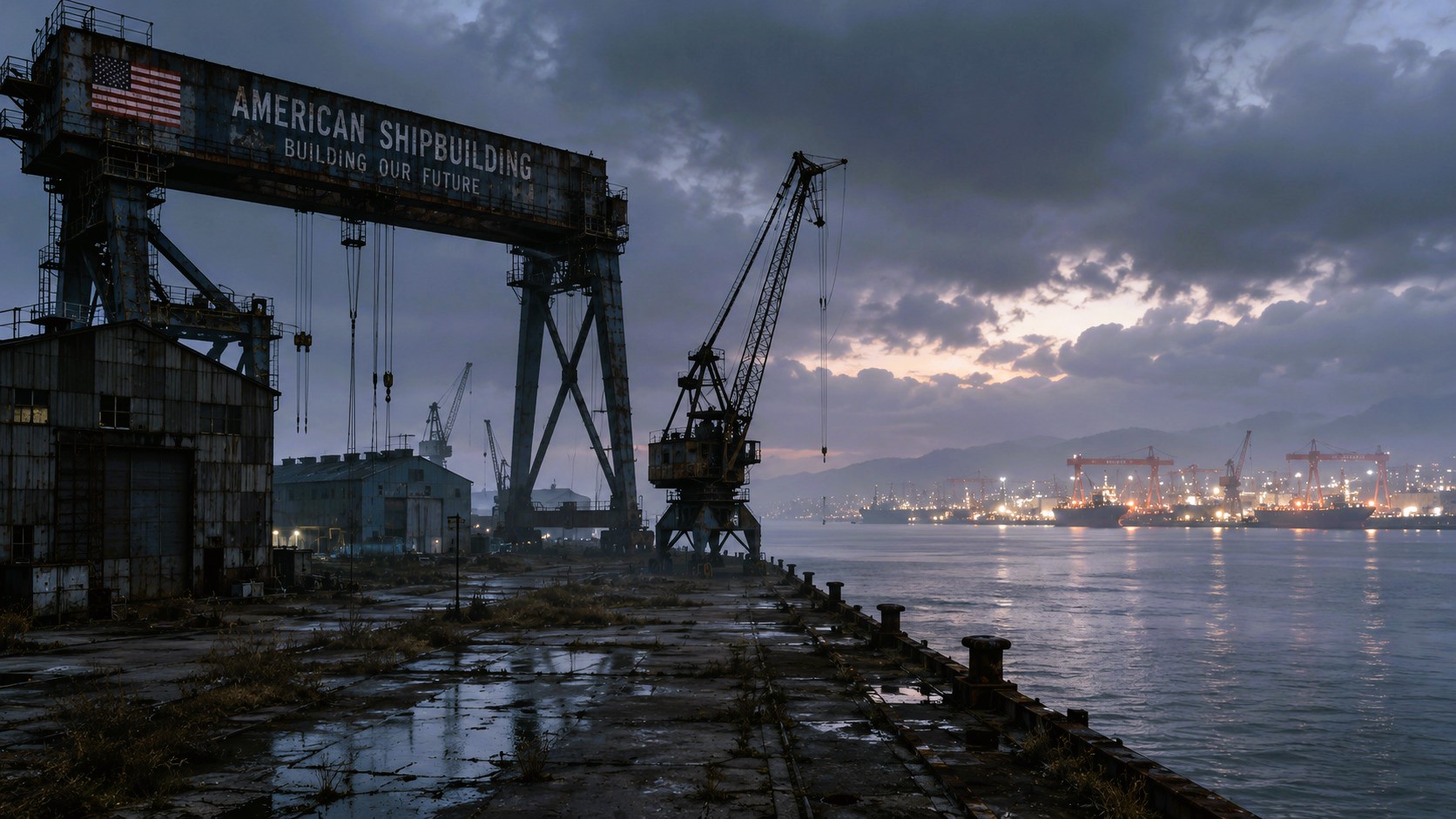

In 1989, while the Berlin Wall still lay in pieces, a young political scientist announced that history had ended. Francis Fukuyama did not mean that events would stop. He meant that the great contest of ideas had closed, and that liberal democracy and the market had won for good. His one worry was almost comic: that we might die of boredom, the last man with nothing left to conquer.
The victory was real. The prophecy, however, was a category error. History simply caught its breath, and then it returned. September 11 came, then two twenty-year wars that ended in retreat, then a financial crisis born inside the winner’s own banks. And finally a rival rose that had never read the eulogy.
More than thirty years later, a Wall Street Journal column by Matthew Hennessey, headlined “The future is not Chinese,” tells us once again that the future is American. It is the same gesture, delivered with the same era confidence. And it deserves a serious answer, precisely because half of it is true. Any honest account of the U.S.–China rivalry has to begin there.
What the triumphalists get right
Start with the concession, because it matters. The largest companies on earth by market value really are American. Nvidia sits at the very top of the table as the most valuable company in the world, and the upper tier speaks English with an American accent. Moreover, Hollywood, pop music and the NBA still project a cultural pull that Beijing cannot match. People risk their lives to reach Los Angeles, not Shenzhen.
All of that is true. Yet all of it measures the surface, and all of it measures the present. The column carries the word “future” in its headline, and that is a different question entirely.
The factory decides the future
Factories build the future, not trading floors, and the world’s factory now sits in China. China produces roughly 30% of global manufacturing output, and no other economy comes close. Indeed, its industrial sector reaches nearly 37% of GDP, more than double the American figure of 17.3%.
Now look at the technologies that will define the next two decades. China accounted for 70.3% of global new-energy vehicle sales in 2025, while its firms installed close to 70% of the world’s electric-vehicle batteries. On top of that, its solar manufacturing capacity alone now covers more than twice the entire planet’s annual demand. These are not toys. They are the commanding heights of the energy century, and one country owns most of them.
So when the triumphalist points to Nvidia and a roster of celebrities, he reads a scoreboard from a game that ended years ago. The board that counts carries very different numbers.
A war the United States cannot resupply
The hardest evidence comes from the institution Americans trust most, their own navy. A leaked Office of Naval Intelligence assessment estimated Chinese shipbuilding capacity at roughly 230 times that of the United States by tonnage, even as the American fleet shrinks toward 287 ships and the Chinese fleet passes 370. That gap is not cosmetic. It is structural.
Numbers like these change the meaning of “victory.” When CSIS ran its Pacific war games, American forces ran out of key long-range precision missiles in under a week, and the global stock of the crucial anti-ship missile sat below 450 against a wartime requirement of 1,000 to 1,200, with yearly procurement of only about 115. Quality wins the first battle. Production wins the war that follows. In any long contest, the U.S.–China rivalry would punish the side that cannot replace what it fires.
And that side is the one with the emptier shipyards. Granted, the American edge in carriers, submarines and combat experience is genuine. Still, it buys a short fight, not a long one.
Every flaw runs both ways
The triumphalist charges China with a familiar list of weaknesses: a demographic cliff, a property bubble, a state that fakes its own numbers. Some of this is fair. The trouble is that almost every item on the list belongs to both players.
Take demographics. The American fertility rate fell to a record low in 2025, nearly a fifth below the level of two decades ago, while population growth collapsed to just 0.3% as immigration dried up. Take prosperity next. One in nine Americans lived below the poverty line in 2024, homelessness reached a record 771,480 people after an 18% jump, and a homeless American can expect to live to about 50, against 77 for everyone else. By contrast, banking fragility and deindustrialization read as purely Chinese problems only to a reader who has forgotten 2008 and 2023.
So the column does not actually compare the two systems. Instead, it chooses its mirrors. It shows China’s scars in daylight, then photographs America in soft focus.
The U.S.–China rivalry is the wrong contest
Here is the deeper error. Power in 2026 no longer behaves like a single trophy that one nation lifts above its head. Rather, it spreads across supply chains, across the algorithms that now command global attention, and across a culture that grows more multipolar every year, from Seoul to Tokyo to Lagos. TikTok, which the column waves away as a trifle, is in fact Chinese-owned control of the very channel through which the West now talks to itself.
Even the cultural confidence rests on borrowed ground. The English language, the common law, the parliamentary form: that world-conquering template came from the British Empire, not from Washington. America inherited the rails and ran its own trains on them, and the U.S.–China rivalry, posed as one prize, hides even this.
Then there is the statistical sleight of hand. Of course China’s GDP per head sits near Mexico’s, at roughly $13,300 against $14,200, and the column says so. Yet it forgets to mention that China’s total economy, at 18.7 trillion dollars, ranks second on earth and runs about ten times the size of Mexico’s. National power lives in the total, not the average.
The man who mistook a ticker for a navy
Triumphalism is not strength. On the contrary, it is the surest symptom of decline. Fukuyama, at least, earned his mistake. He watched an empire collapse and confused an ending with the ending. Hennessey earns nothing of the sort. He is no strategist, no economist, no student of China. He edits other people’s opinions for a living, and he once wrote a book called Visible Hand: A Wealth of Notions on the Miracle of the Market. That title is the entire confession.
A man who worships the miracle of the market will always read a stock ticker as if it were a map of the world. So he counts Nvidia, tallies the celebrities, and adds up the market caps. Then he declares the contest finished, because in his catechism the price is the truth and everything else is noise. Meanwhile, an ocean away, the shipyards that out-build his country 230 to one keep humming, and the missiles his navy would burn through in a week sit unbuilt on a spreadsheet. He mistook a ticker for a navy. Whoever reads the U.S.–China rivalry off a stock screen has already surrendered the only part that counts. Triumphal headlines are cheap. Shipyards are not. The men who confuse the two should perhaps follow Séguéla’s lead and confess: better a pianist in a brothel than the herald of a victory the shipyards never voted for.
The future is not American, and it is not Chinese. The future has no flag. It answers to no headline, no ticker, and no wealth of notions. It belongs to whoever keeps building the ships, while the other side throws itself a party and files the press release.
Postscript: the diplomacy of metaphor
As this essay went to press, Brussels supplied an unintended footnote to its argument. Kaja Kallas, the European Union’s foreign policy chief, compared dealing with China to treating a fatal illness. A patient, she told the Lennart Meri Conference in Tallinn, chooses between two paths: “Either increase the morphine or you start chemotherapy.” The morphine, in her telling, means subsidising European firms. The chemotherapy means turning hostile to Chinese ones.
Read that metaphor again, because it refutes itself. In the same breath, Kallas listed the sectors where she says China now dominates: batteries, chemicals, shipbuilding and raw materials. So the “cancer” she wants to irradiate is, by her own inventory, the productive supremacy that Europe no longer holds. Beijing builds the batteries and the ships; Brussels reaches for the cancer ward to describe them. Moreover, millions of people live with cancer, fight through it, and bury those they love because of it. They are not a rhetorical prop for a diplomat who has run short of leverage.
This is not one stray line, and that is the real point. Kallas had already mused about “dismembering” Russia, and discovered in 2025 that it was “news” to her that the Soviet Union helped defeat the Nazis. Her predecessor Josep Borrell told a room of young diplomats in 2022 that “Europe is a garden” while “the rest of the world is a jungle,” a remark that prompted the United Arab Emirates to summon the bloc’s envoy and forced a grudging apology. So the metaphors keep arriving, and each one announces the same thing: a Europe that has lost the factory consoles itself with the phrase. The future has no flag. It will certainly not answer to a punchline about chemotherapy.