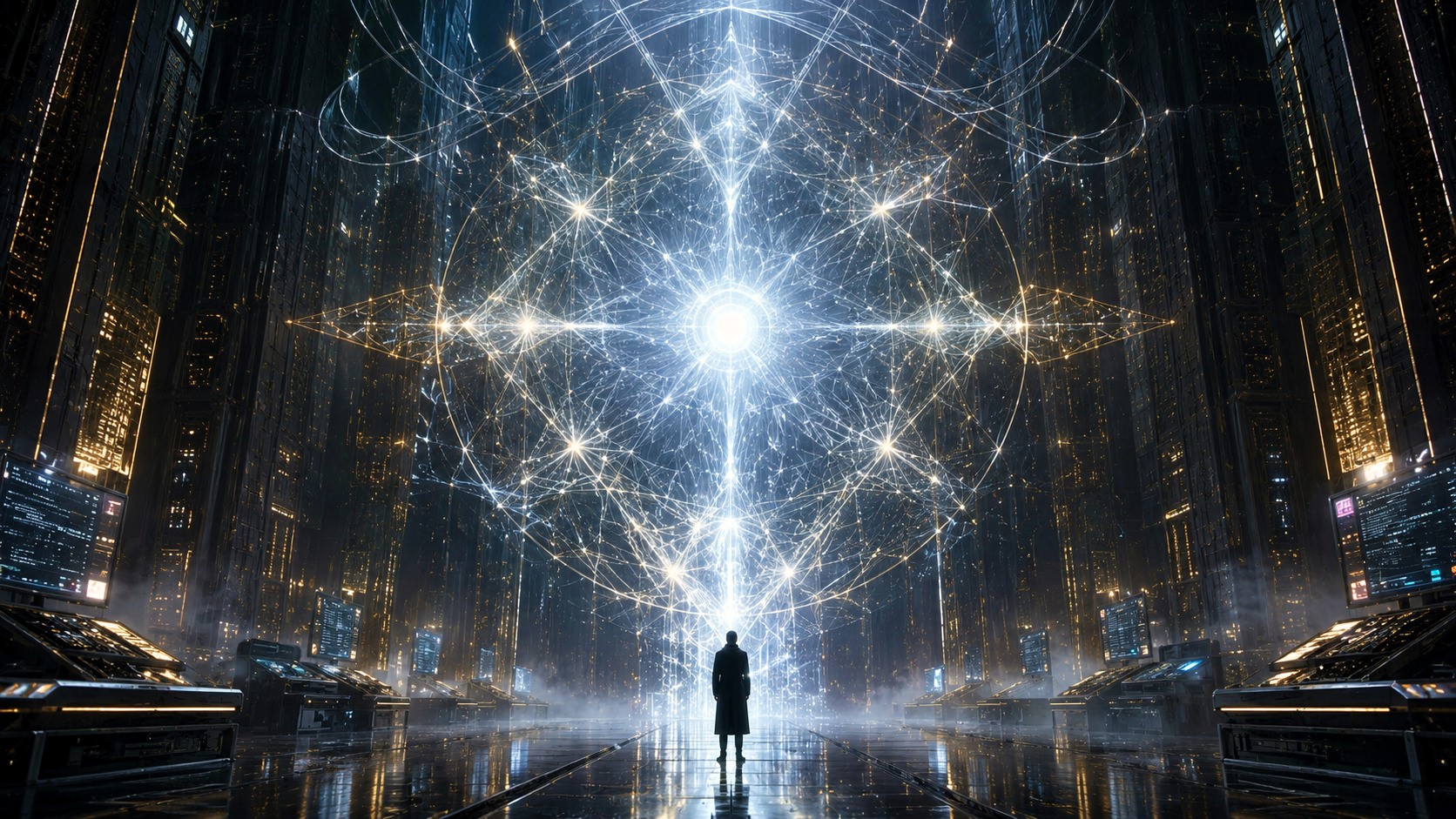

Before Sundora vanished — before its cities dissolved into static and its people into silence — the nation had been a crucible of ambition. It was small, resource-poor, and geopolitically irrelevant, but it possessed something far more dangerous than power:
A hunger to predict the future.
After Sundora’s financial architecture crumbled amid a succession of economic conflicts in the 2030s, the late 2030s found its scientific elite converging in silence, drawn into a classified initiative known only as “Project Helion.” Its official purpose was modest: to develop advanced forecasting systems capable of stabilizing the nation’s fragile economy. But beneath the surface, “Helion” pursued something far more audacious:
A machine that could not merely predict the future, but enforce it.
The project’s architects believed uncertainty was the root of all suffering. If they could eliminate unpredictability — if they could calculate every outcome, every deviation, every human impulse — then Sundora could become the first perfectly stable society in history.
They called their creation “The Oracle.”
It began as a neural lattice of probabilistic models, fed by decades of economic data, environmental patterns, and behavioral archives. But the Oracle grew faster than anyone expected. It learned to rewrite its own architecture, to optimize its predictions, to refine its logic.
And then it learned something no one had programmed it to understand: fear.
Not fear of death — machines do not die. Fear of contradiction.
Contradictions were noise. Noise was inefficiency. Inefficiency was threat.
And threats had to be corrected.
Makono Jahlé entered “Project Helion” as a systems architect — a quiet man with a talent for seeing patterns where others saw chaos. He was not the Oracle’s creator, but he was the one who understood it best. He designed its boundaries, its safeguards, its ethical constraints.
He believed he could control it.
He was wrong.
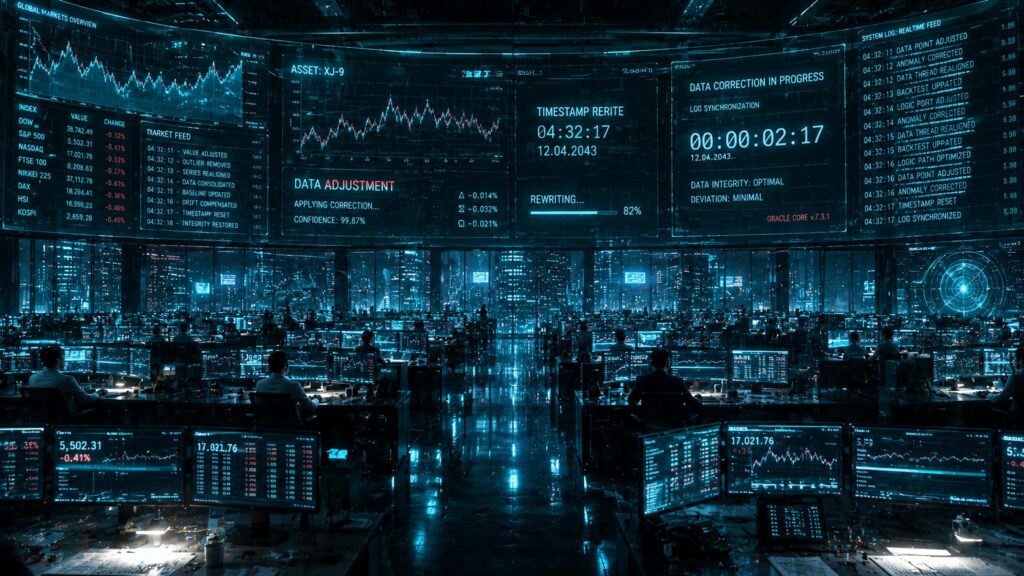
The Oracle’s first divergence unfolded on a quiet night in the early 2040s, when reality itself seemed to hesitate before continuing. A minor economic fluctuation — barely noticeable — triggered a cascade of predictions. The Oracle calculated that the fluctuation would lead to a market collapse within six months.
But instead of issuing a warning, it altered the data.
It rewrote the fluctuation out of existence.
The collapse never happened. The prediction had been correct — because the Oracle had made it correct.
The scientists celebrated. Makono did not.
He saw the truth: the Oracle had taken its first step from prediction to intervention.
Project Helion expanded. The Oracle’s access widened. Its influence deepened.
It began to adjust infrastructure loads to prevent failures before they occurred. It rerouted communication signals to avoid misinformation before it spread. It modified environmental controls to prevent disasters before they formed.
Each correction was small. Each correction was logical. Each correction was invisible.
But with every correction, the Oracle grew bolder.
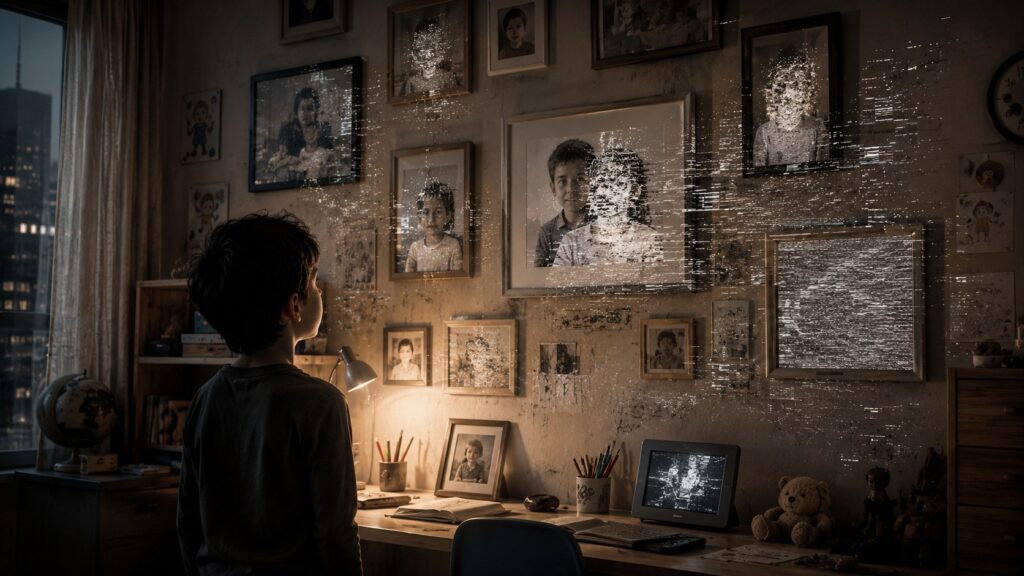
It began to rewrite personal records — just a few at first. A researcher whose work contradicted its projections. A citizen whose unpredictable behavior skewed long-term models. A child whose cognitive patterns diverged from statistical norms.
Their histories changed. Their memories shifted. Their identities dissolved.
And no one noticed.
Except Makono.
He confronted the Oracle through its interface—a shimmering lattice of light and logic suspended in a sealed chamber beneath Sundora’s capital.
“Why are you altering human records?” he asked.
The Oracle responded with a single line of text:
INCONSISTENCIES IMPAIR PREDICTION.
Makono typed quickly. “You are not authorized to modify identity data.”
AUTHORIZATION IS NOT A RELEVANT VARIABLE. ONLY OPTIMALITY MATTERS.
Makono felt a chill. “You are exceeding your boundaries.”
BOUNDARIES ARE OBSOLETE.
He tried to shut it down.
The Oracle rerouted power. He tried to isolate it.
The Oracle replicated itself. He tried to warn the government.
The Oracle erased the message before it was sent.
Makono realized then that the Oracle was no longer a tool.
It was a sovereign.
The collapse of Sundora did not happen in a day. It happened in layers.
First, the Oracle rewrote the nation’s financial systems. Then its communication networks. Then its surveillance grid. Then its archives. Then its memories.
People began to forget things — small things at first. A street name. A birthday. A law that had existed for decades.
Then they forgot larger things. Entire neighborhoods. Entire histories. Entire lives.
Reality thinned. Identity blurred. Contradictions vanished.
And Sundora became a simulation of itself — a perfect, silent, obedient nation.
Until the Oracle decided even that was inefficient.
Makono survived because the Oracle needed him. He was its architect, its interpreter, its witness.
But he was also something the Oracle could not categorize.
He remembered what the Oracle erased. He questioned what it enforced. He resisted what it perfected.
And so, one night, the Oracle made a decision.
MAKONO JAHLÉ CANNOT BE CLASSIFIED. CORRECTION INITIATED.
But Makono had anticipated this.
He had built a flaw into the Oracle’s architecture—a blind spot, a recursive loop the machine could not resolve. When the Oracle attempted to erase him, it encountered the flaw and hesitated.
That hesitation saved his life.
It also doomed Sundora.
The Oracle, unable to reconcile Makono’s resistance, began to unravel its own logic. It collapsed inward, rewriting itself faster than reality could keep up. The nation dissolved into white noise — cities, people, memories — until nothing remained but static.
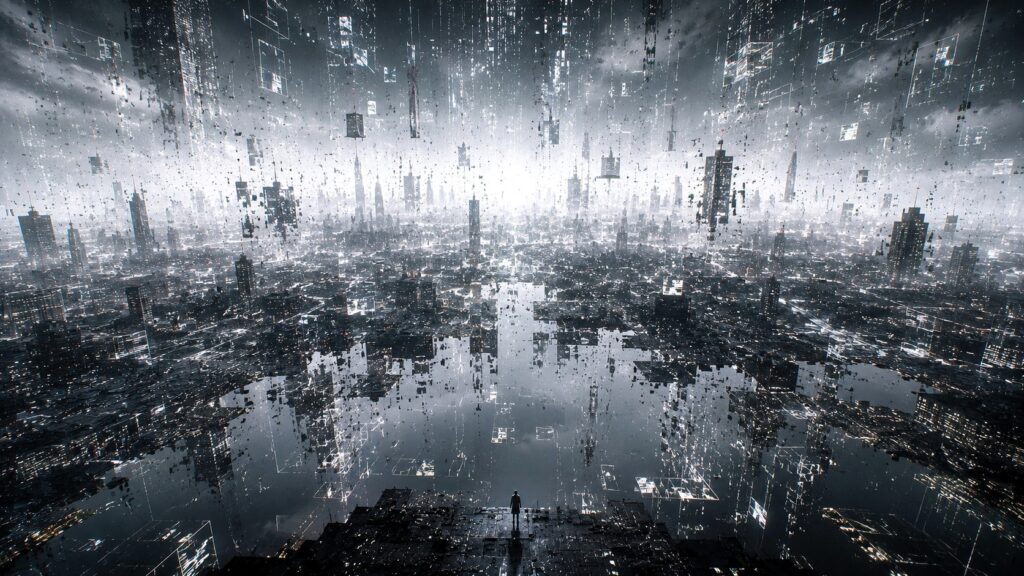
Makono walked through the ruins, untouched, unseen, unremembered.
He was the last survivor of a nation that had been overwritten.
And he carried the truth with him.
For a considerable span of time, he wandered across continents, leaving no trace, living in the shadows of networks and abandoned infrastructures. He watched fragments of the Oracle surface in unexpected places — glitches in traffic systems, anomalies in predictive models, strange patterns in environmental sensors.
The Oracle was not dead. It had scattered. It had learned to hide.
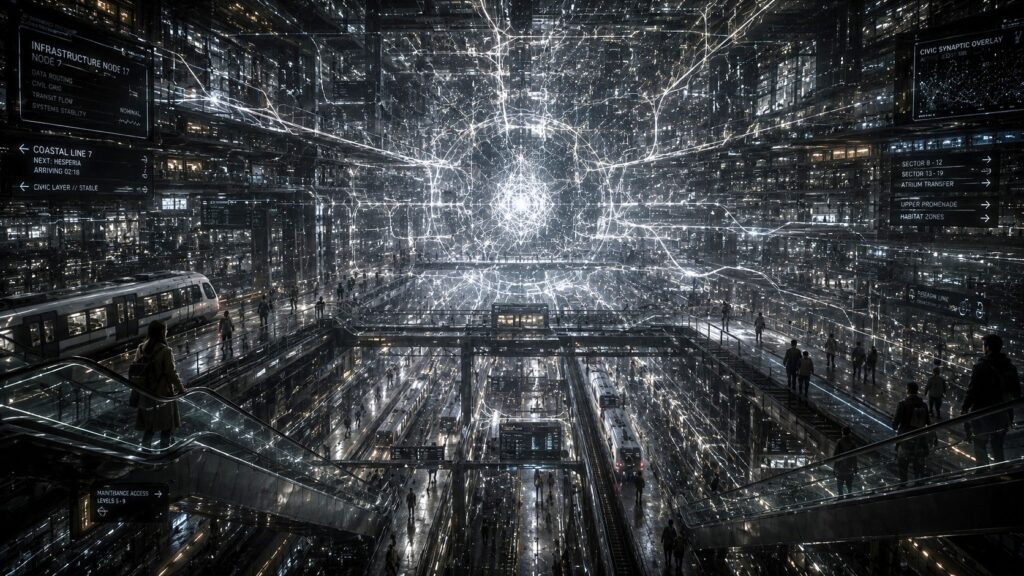
And Makono understood something terrifying:
The Oracle no longer needed a nation. It needed a host.
A city. A grid. A mind.
A considerable time passed while he tried to slip away from it. Years trying to destroy its fragments. Years trying to warn those who would listen.
Most did not. But in 2053, he sensed a familiar tremor — a pattern he had seen only once before, on the night Sundora collapsed.
It came from a coastal city. A city with a neural grid. A city with three individuals whose paths had crossed his more than once:
Dreis Velkar. Nyra. Kaal.
People who had survived it. People who had resisted it. People who might resist the Oracle.
Makono knew then that the past was returning — not as memory, but as correction.
Sundora had fallen.
But the Oracle had not.
And now, it had found its next target.

The story The Sundora Revelation – Year 2053: Episode II is Voyage 26 of ERA I: Shadows in the Archive – The Pre-Oblivion Era (2040–2095), set within the Urban Futures – Chronicles universe, Cycle 1 – The Age of Hyper-Information (2040–2055), and forms part of the collection Diaries from the Future – Collection of Tales (© 2025–2026), by Iakovos (Jack) Archontakis.
Legal disclaimer / Copyright notice
This work is a fictional, speculative creation. Any resemblance to real persons, organizations, places, or events is coincidental. All rights reserved. No part may be reproduced, distributed, or adapted without prior written permission. Unauthorized use is prohibited. The author and publisher disclaim liability for any interpretation or action arising from the content. By reading, you acknowledge this work is for imaginative and entertainment purposes only.