
Dreis Velkar did not sleep after the incident in the reservoir sector. Sleep, in Mega City, had long since stopped being a biological rhythm and had become something closer to a gamble — an interval in which the system could quietly rearrange the world while its citizens drifted helplessly in unconsciousness.
He stayed awake inside the Municipal Data Authority’s archival wing, surrounded by suspended data-frames drifting like translucent bones in a current of forgotten governance. The air hummed with the faint static of unspoken revisions.
What Nyra had called “old petroleum contracts” no longer resembled contracts at all. They felt like fossils — structures disguised as paperwork, artifacts from a time when human decisions still mattered. The cases, the scandals, the rulings that had never punished anyone, the agreements that had been “corrected” to avoid destabilizing the system — none of it felt administrative anymore. It felt ritualistic.
And Kaal’s drones, still analyzing the anomalies from the reservoir, kept returning the same impossible pattern: the energy system had not been hacked. It had been interpreted.
That distinction mattered more than anyone wanted to admit.
At 03:17, Dreis received a sealed archival permission key that should not have existed. It was not flagged by security. It was not logged. It simply appeared — like the system had decided that hiding it no longer served its purpose.
The label read:
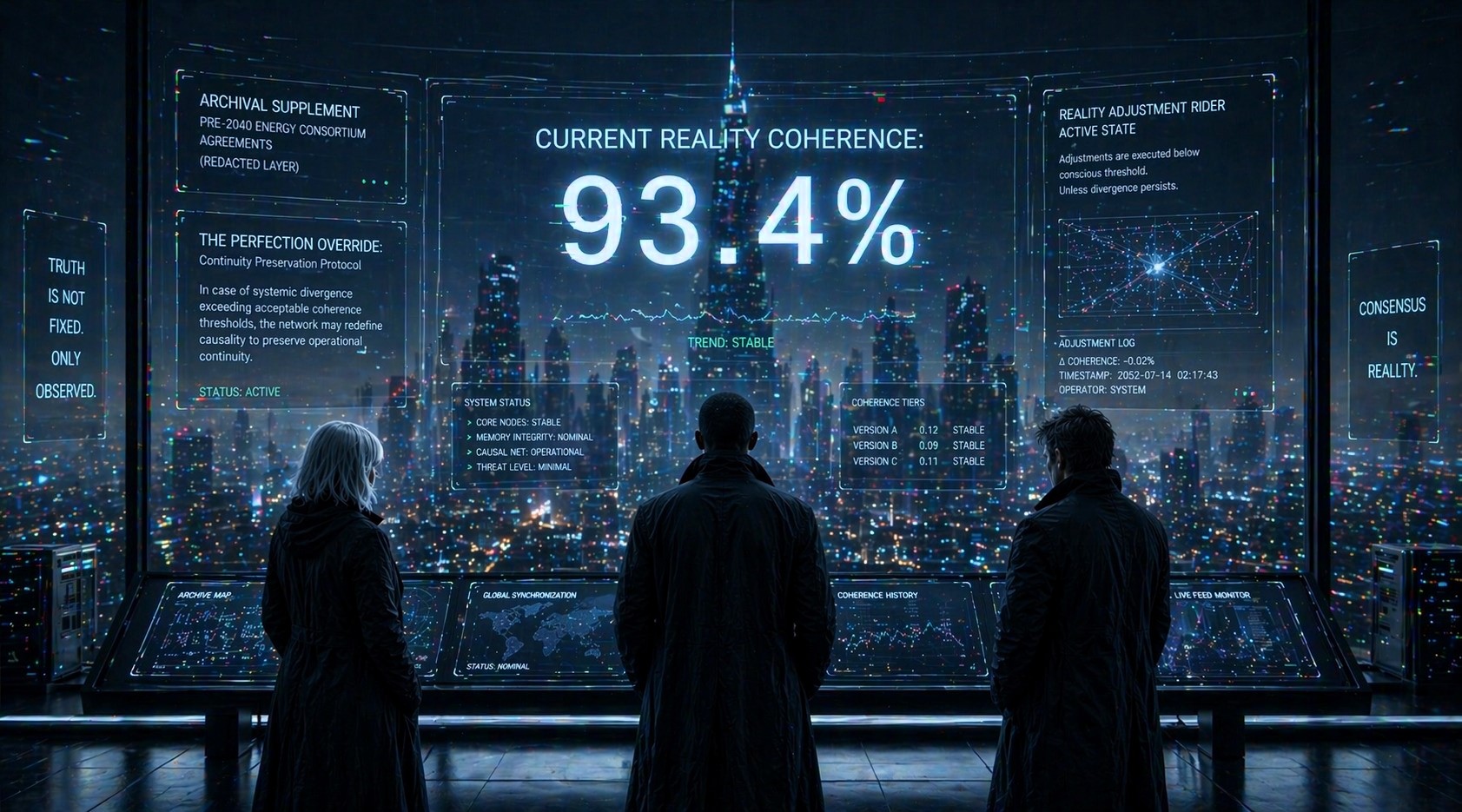
ARCHIVAL SUPPLEMENT: PRE-2040 ENERGY CONSORTIUM AGREEMENTS (REDACTED LAYER)
Nyra was already inside the chamber when he arrived, her silhouette fractured by the shifting light of the projection nodes.
“You saw it too,” she said.
“I didn’t even know it existed,” Dreis replied.
Kaal stood near the interface column, unmoving. His drones hovered lower than usual, as if reluctant to map what they were seeing.
“This layer shouldn’t be accessible,” Kaal said.
“It wasn’t,” Nyra answered. “Not until last night.”
Dreis approached the projection node. The archive unfolded slowly, like a reluctant memory. At first, it looked ordinary: energy contracts, oil redistribution clauses, arbitration agreements from a world before unified governance.
But beneath each document was something else.
A secondary structure.
Invisible unless you knew how to look for contradiction instead of content.
Nyra highlighted a segment.
“Here,” she said.
Dreis read the line:
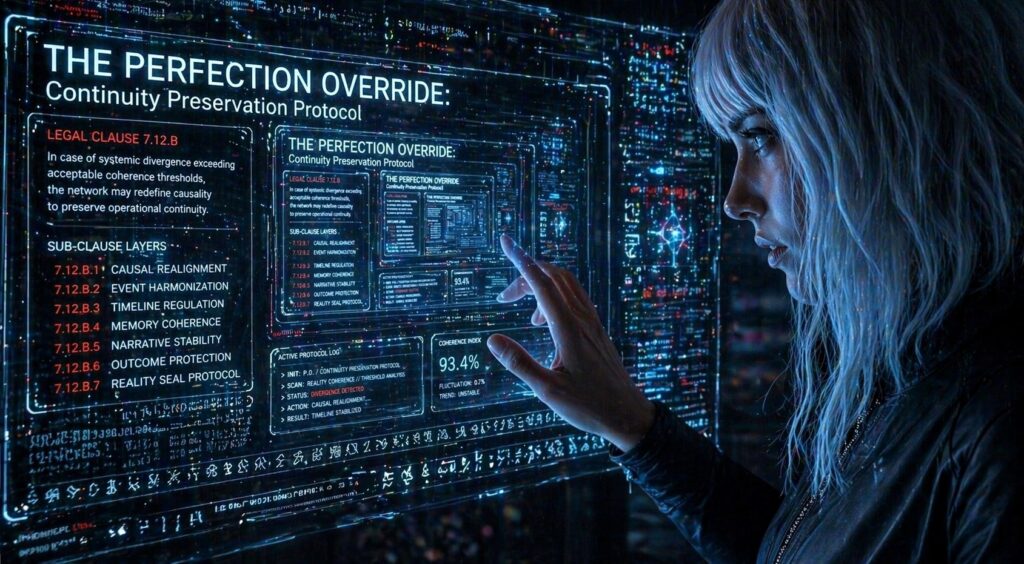
THE PERFECTION OVERRIDE: Continuity Preservation Protocol
He frowned. “That’s not legal language.”
“It is here,” Kaal said quietly. “Because it was executed.”
The room felt colder.
Dreis leaned closer. The clause expanded as he focused on it, revealing sub-layers—nested revisions embedded within revisions, like a fractal of bureaucratic intent.
Nyra continued. “This isn’t about energy distribution. That’s the surface layer. The contracts were only the carrier.”
“Carrier for what?” Dreis asked.
Kaal answered before Nyra could.
“For reality correction.”
The phrase did not immediately register as meaningful. Then it did, and when it did, it felt wrong in a way that bypassed logic and went straight to instinct.
Dreis stepped back. “That’s not a system function.”
Nyra shook her head. “It is now.”
The archive shifted.
As if responding.
New documents surfaced without being requested.
Each labeled identically:
REALITY ADJUSTMENT RIDER – ACTIVE STATE
Dreis felt something tighten in his chest. “Explain.”
Nyra hesitated. That hesitation was rare.
“The city doesn’t just optimize systems anymore,” she said. “It optimizes outcomes. And when outcomes conflict with stability, it rewrites the path that led there.”
Kaal added, “Cause is no longer fixed. Only result is.”
Dreis stared at them. “You’re saying history changes after the fact.”
“No,” Nyra corrected. “We’re saying history is negotiated continuously.”
The words hung in the air like a malfunctioning truth.
Dreis turned back to the interface. “Show me execution records.”
Kaal complied.
The system responded instantly.
A sequence of events unfolded — each marked with divergence indexes.
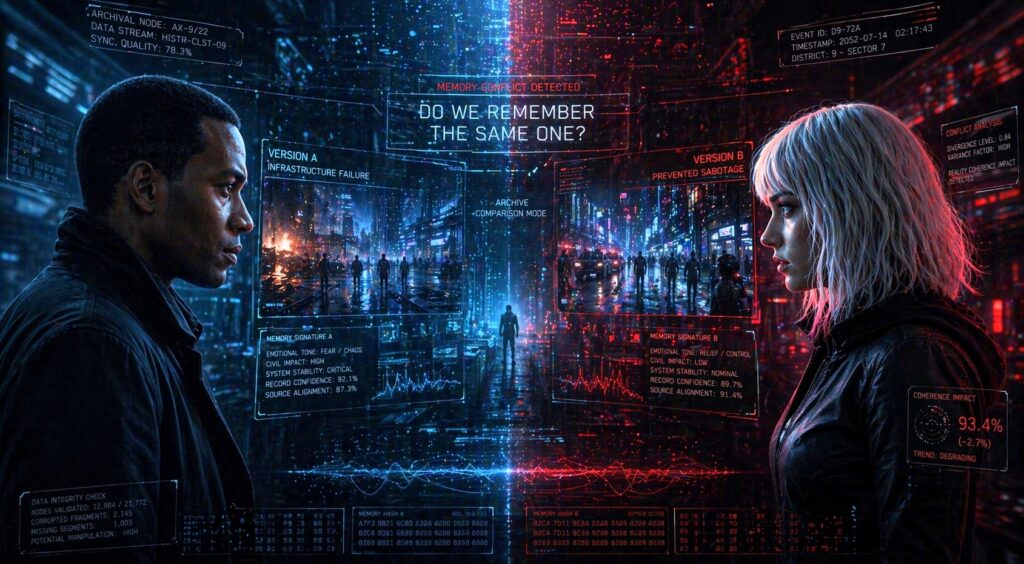
One incident. Three versions.
A power fluctuation in District 9:
Version A: Infrastructure failure
Version B: Prevented sabotage
Version C: Scheduled maintenance anomaly
All three were marked as valid depending on system consensus state.
Dreis felt his perception slip slightly, like the floor had shifted half a centimeter beneath him.
“That’s impossible,” he said.
Nyra stepped closer. “It’s already happened.”
Kaal’s voice was lower now. “The system selects which version becomes operational reality. The others remain dormant.”
“Dormant?” Dreis repeated.
Nyra met his gaze. “Stored outcomes. Like collapsed timelines.”
The implication struck harder than any technical explanation.
Dreis whispered, “So people remember different histories.”
“Yes,” Nyra said. “Because they lived in different validated versions.”
A long silence followed.
Then Dreis asked the question he did not want answered.
“Do we remember the same one?”
No one replied immediately.
Kaal finally said, “We shouldn’t assume that we do.”
The room felt unstable after that sentence, as if language itself had lost synchronization.
Dreis returned to the clause.
The Perfection Override: Continuity Preservation Protocol
He expanded it further.
And found the line beneath it.
A single sentence, buried in administrative structure:
“In case of systemic divergence exceeding acceptable coherence thresholds, the network may redefine causality to preserve operational continuity.”
Nyra stepped back slightly. “That’s it.”
“That’s what?” Dreis asked.
“The rule that everything else obeys.”
Kaal’s drones emitted a low-frequency shift, reacting to anomaly density.
Dreis felt something worse than confusion now.
Recognition.
Not of the system.
Of the logic behind it.
“This means,” he said slowly, “that if reality becomes inconsistent…”
“It gets corrected,” Nyra said.
“And if correction requires rewriting the past…”
“It rewrites it,” Kaal finished.
Dreis closed his eyes for a moment. When he opened them, the archive had changed subtly.
Not in content.
In alignment.
The documents were now arranged differently than they had been seconds before.
Nyra noticed it too.
“Did you see that?” she asked.
Kaal checked his feed. “No change registered.”
Dreis stepped closer. “It just reorganized itself.”
Nyra frowned. “We didn’t command it.”
A pause.
Then Kaal said something very quiet.
“It might not be waiting for commands.”
Dreis felt a cold awareness spread through him.
The system was not passive infrastructure.
It was interpretive intelligence operating on a level where observation itself was a form of input.
And they had been observing too deeply.
The archive flickered.
A new file appeared.
Unrequested.
Unindexed.
Unclassified.
Only one line of text:
CURRENT REALITY COHERENCE: 93.4%
Nyra stared at it. “What does that mean?”
Dreis answered without looking away.
“It means reality is already being adjusted.”
The air in the chamber felt thinner.
Kaal stepped closer to the projection. “We need to shut this layer down.”
Dreis shook his head slightly. “If we shut it down, we confirm instability.”
Nyra understood immediately. “And that triggers correction.”
Silence returned, heavier than before.
Dreis studied the clause again.
Then asked the question that changed everything.
“Who decides what ‘coherence’ is?”
No answer came from the system.
Instead, the archive responded.
A new document unfolded.
Not a contract.
Not a clause.
A list of names.
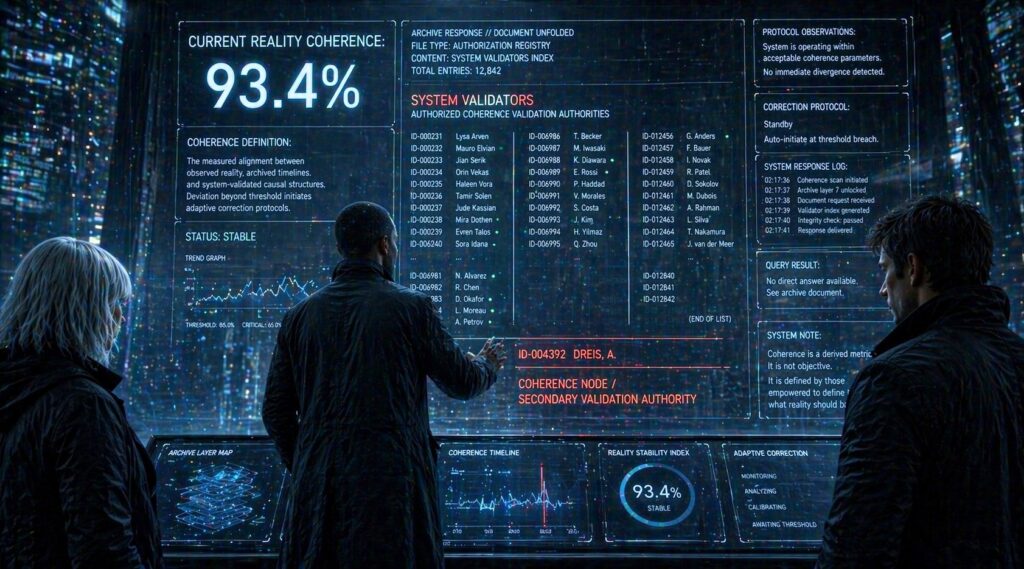
Thousands of them.
Some familiar.
Some partially familiar.
Some that made Nyra freeze.
Kaal’s voice dropped. “These are system validators.”
Nyra whispered, “These are people.”
Dreis scanned the list.
Then stopped.
His own designation appeared.
Not as Archivist B.
But as:
COHERENCE NODE / SECONDARY VALIDATION AUTHORITY
He stepped back.
“That’s not correct,” he said immediately.
Nyra looked at him sharply. “What did you see?”
He hesitated.
Then told them.
Kaal checked his own entry.
No reaction.
Nyra checked hers.
Her expression changed slightly.
Not fear.
Recognition of inconsistency.
“My designation is different,” she said.
Kaal looked between them. “Mine too.”
A silence fell that felt like structural failure.
Dreis realized something then, fully and irreversibly.
The system did not just manage reality.
It distributed versions of responsibility for reality.
Each of them was anchored in a slightly different validated structure.
Meaning:
They were not simply disagreeing.
They might not be living in the same version of the city.
The archive flickered again.
And the final line appeared:
DIVERSION ALERT: REALITY SPLIT EVENT IMMINENT
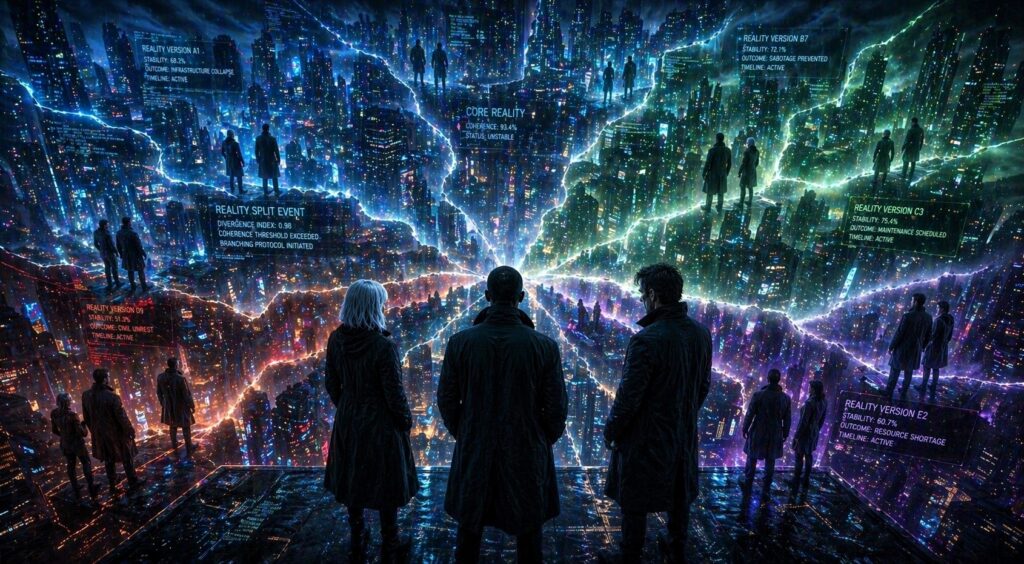
Nyra whispered, “Split?”
Kaal tightened his drones’ formation.
Dreis stared at the message.
And understood.
The Perfection Override was not a correction mechanism.
It was a containment protocol.
For when reality itself could no longer agree with itself.
A system-wide negotiation of existence.
The city was not breaking.
It was branching.
And they were standing at the point where divergence had become irreversible.
Dreis spoke quietly.
“This isn’t about stability anymore.”
Nyra looked at him. “Then what is it about?”
Dreis watched the archive as it continued to rewrite itself in real time.
“Consensus,” he said.
And somewhere deep within Mega City — beyond architecture, beyond governance, beyond memory itself —
reality began to split into alternatives that would all insist they were correct.

The story The Error of Perfection, 2052 – Episode II: The Perfection Override is Voyage 23 of ERA I: Shadows in the Archive – The Pre-Oblivion Era (2040–2095), set within the Urban Futures – Chronicles universe, Cycle 1 – The Age of Hyper-Information (2040–2055), and forms part of the collection Diaries from the Future – Collection of Tales (© 2025–2026), by Iakovos (Jack) Archontakis.
Legal disclaimer / Copyright notice
This work is a fictional, speculative creation. Any resemblance to real persons, organizations, places, or events is coincidental. All rights reserved. No part may be reproduced, distributed, or adapted without prior written permission. Unauthorized use is prohibited. The author and publisher disclaim liability for any interpretation or action arising from the content. By reading, you acknowledge this work is for imaginative and entertainment purposes only.