
In 2003, Chinese President Hu Jintao warned of what he called the “Malacca Dilemma”: China’s existential vulnerability to any power capable of closing the Strait of Malacca, through which most of its energy imports passed. The warning entered the strategic literature and was largely forgotten. It should not have been.
Today, the dilemma has a new name and a new address. Before the U.S.-Israeli assault on Iran in late February 2026, China received approximately 5.35 million barrels of oil per day through the Strait of Hormuz. After Iran closed the strait to Western-aligned shipping, that figure collapsed to roughly 1.22 million. In a matter of weeks, China’s most fundamental vulnerability became its most urgent reality. China imports approximately 40% of its oil from the Middle East, and every critical maritime artery — Hormuz, Malacca, Lombok, Sunda — runs through waters where American naval power can be deployed at will.
The sea, in short, belongs to someone else. Which is precisely why China spent the past decade building a different kind of insurance policy, on land, through the Central Asia corridor. The policy is now the plan.
The infrastructure built before it was needed
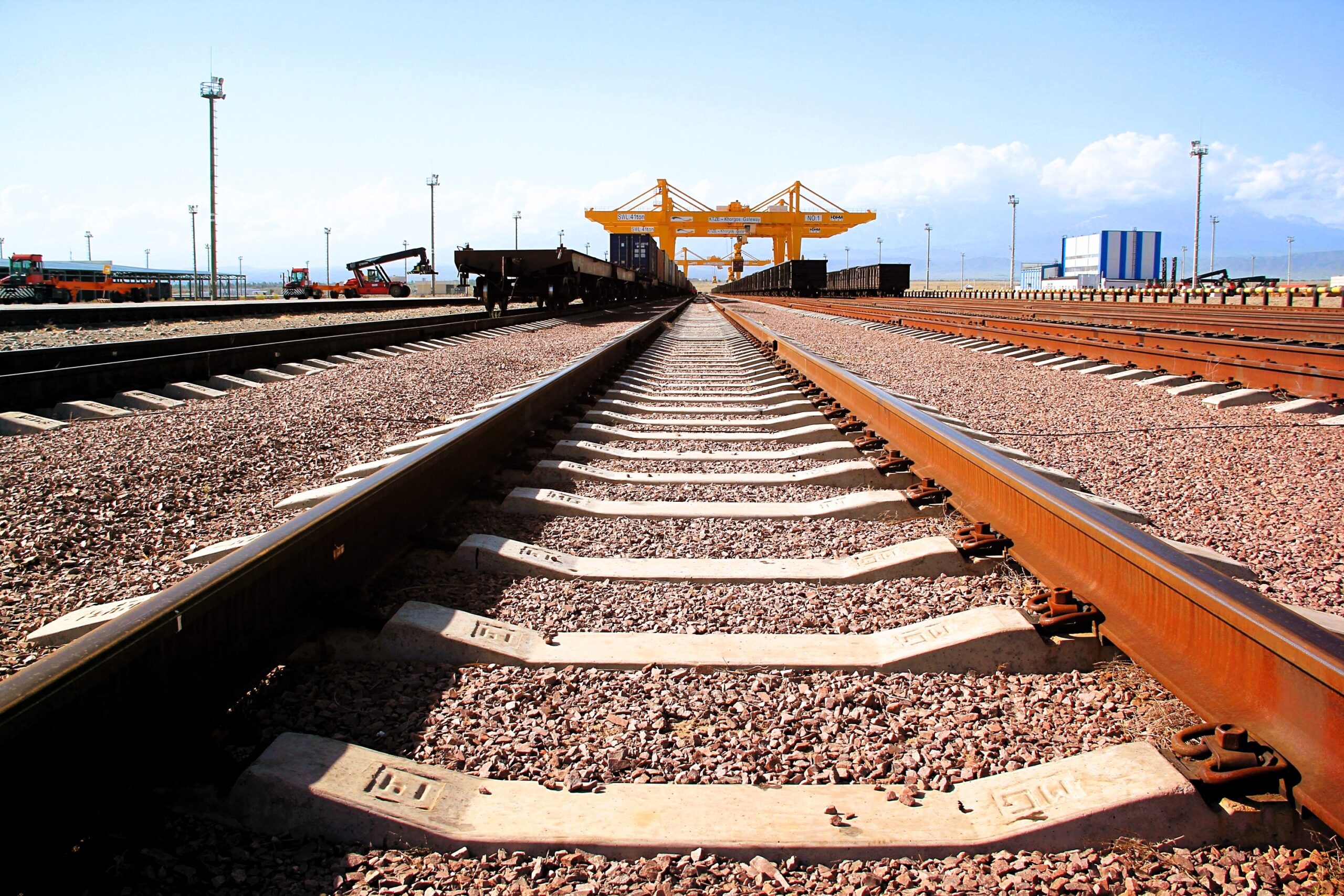
The numbers tell a story that no official communiqué fully captures. Since the first China–Central Asia Summit in Xi’an in 2023, trade between China and the five Central Asian states has grown by 35%, reaching nearly $100 billion in 2024. In 2023 alone, some 63,000 electric vehicles crossed into Central Asia via the Khorgos Gateway dry port — a year-on-year increase of 585.6%. In the first half of 2025, Kazakhstan attracted approximately $23 billion in BRI-related investments, representing 92% of all China’s BRI investment directed at Central Asia.
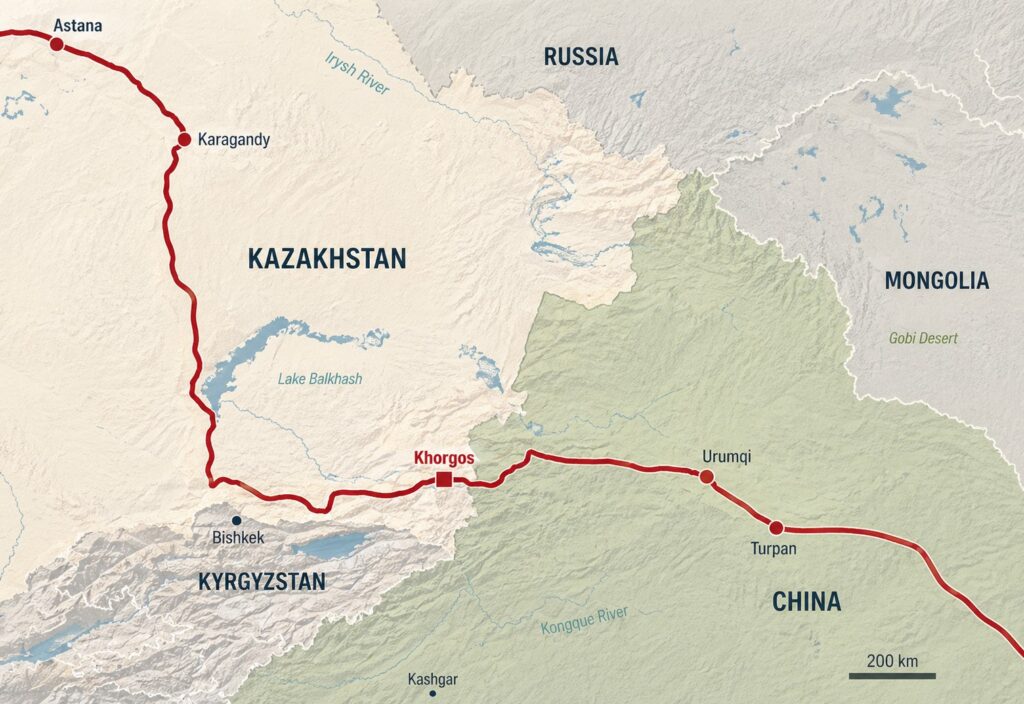
At the centre of this architecture stands the China–Kyrgyzstan–Uzbekistan railway. In December 2025, the project’s financing agreement was signed: a $4.7 billion undertaking in which China provides $2.3 billion as a 35-year concessional loan and holds 51% of the joint venture. Once operational, the line will reduce transit time between China and Europe by seven to ten days compared to the northern route through Russia, and it will cut the overland distance by approximately 900 kilometres. Construction of the Kyrgyz section, which involves 29 tunnels and 50 bridges across technically demanding mountain terrain, started in 2025 and targets completion by 2030.
Speaking at the inauguration ceremony, Kyrgyz President Sadyr Japarov was uncharacteristically direct: “If now we live in a dead-end country between Europe and China, with the completion of the CKU railway we will turn into a transit power.” At the second China–Central Asia Summit in Astana in June 2025, President Xi Jinping framed the broader agenda with equal bluntness, telling assembled Central Asian heads of state: “There are no winners in tariff and trade wars,” before announcing 12 new cooperation agreements covering the Belt and Road Initiative, green minerals, customs, and connectivity. The Central Asia corridor, in other words, is not a contingency. It is the primary structure.
Three capitals, three agendas
The Chinese narrative presents Central Asia as a region of shared destiny, mutual benefit, and cooperative development. It is a tidy story, and like most tidy stories about this part of the world, it leaves out rather a lot.
Consider Kazakhstan. Under President Kassym-Jomart Tokayev, Astana has pursued a multi-vector foreign policy with genuine sophistication. In 2025, Tokayev signed 29 cooperation agreements worth nearly $17 billion during his landmark visit to Washington — the first official White House reception of a Kazakh head of state under his presidency — while simultaneously concluding 24 intergovernmental agreements with Beijing, formally elevating the relationship to an “eternal comprehensive strategic partnership.” A Kazakh customs crackdown in the same year left more than 5,000 Russian-bound freight trucks stranded at the border, a material signal that Astana was enforcing sanctions-adjacent restrictions against Moscow. Tokayev is not choosing sides. He is raising the price of choosing him.
The European Union occupies a more ambivalent position. Brussels formally incorporated the Trans-Caspian International Transport Route into its Global Gateway strategy and emerged as one of the two largest investors in Central Asia corridor infrastructure alongside China. Yet the two parties pursue sharply different objectives. For the EU, the route is a tool of strategic autonomy, a way to diversify supply chains and reduce exposure to political coercion. For China, it is a tool of strategic survival. The EU’s execution gap is real: Global Gateway remains chronically underfunded relative to its stated ambitions, with committed capital consistently falling short of BRI disbursement rates in the region. Shared infrastructure, it bears repeating, does not imply shared purpose.
Uzbekistan, meanwhile, welcomes the CKU railway with genuine enthusiasm. Its minister of investment, Laziz Kudratov, described the project as “the shortest land route connecting China with Central Asia” and noted growing interest in settling bilateral trade in Chinese yuan. What Tashkent tends not to dwell on is the structural arithmetic: China holds a majority stake in the joint venture and will control routing priorities and logistics decisions. The risk that Uzbekistan becomes a downstream endpoint in a China-managed Central Asia corridor, rather than a genuine node in a multipolar network, is real and largely undiscussed in official circles.
The cracks in the corridor
The Central Asia corridor is a compelling answer to China’s maritime exposure. It is not, however, a clean one.
Trade along the Middle Corridor dropped 37% between 2022 and 2023, driven by bottlenecks, logistical failures, and capacity constraints that pushed freight operators back toward traditional routes. The Trans-Caspian segment depends on Azerbaijani and Turkish cooperation, two actors with their own negotiating agendas and no particular obligation to prioritise Chinese throughput. The CPEC route through Pakistan faces persistent pressure from the Baloch insurgency, which has evolved into a more distributed and technically capable threat. Furthermore, every overland route to Europe eventually passes through jurisdictions that Washington, Brussels, or Ankara can influence in ways Beijing cannot fully anticipate.
There is also the question of what the Hormuz crisis has done to Iran’s own corridor role. Iran announced that vessels from China, Russia, India, Iraq and Pakistan would be permitted to transit the strait, while effectively blocking Western-aligned shipping. Tehran is also reportedly considering allowing cargoes denominated in Chinese yuan to pass freely, a move that would redirect energy flows and challenge dollar primacy in commodity markets. This gives China a partial solution to its maritime problem. A solution that depends on the continued goodwill of a country under active military assault is, to put it diplomatically, an imperfect hedge.
The deeper problem is structural: China builds alternative overland routes to reduce dependence on chokepoints it does not control, yet every one of those routes runs through territories it also does not control. The real trade-off is not between land and sea, but between control and exposure. Maritime routes offer scale without sovereignty; overland corridors offer partial control without scale. The Central Asia corridor cannot replicate the volume of seaborne energy flows that pass through Hormuz or Malacca, which together handle tens of millions of barrels per day, a scale that overland rail corridors simply cannot approach: China Railway Express moved roughly 2.08 million TEU in 2024, a figure that fell further in 2025 despite growth in Central Asia-bound flows. The geography of Eurasia offers no clean exits. China can reroute risk, but it cannot eliminate it.
Three scenarios for 2030
The first scenario is functional consolidation. The CKU railway reaches operational status by 2030, the Trans-Caspian route stabilises, and the Central Asia corridor network achieves sufficient capacity to absorb 30 to 40% of China’s overland trade with Europe. Central Asian states extract meaningful transit revenues and use them to reinforce their multi-vector strategies. The system works, imperfectly but durably.
The second scenario is competitive fragmentation. The United States, the EU, and China each pursue incompatible visions for the same infrastructure. Central Asian states leverage the competition effectively but cannot prevent the Central Asia corridor from fracturing along geopolitical lines. The result is a patchwork of routes that are individually insufficient and collectively unreliable, precisely the worst outcome for a region that requires integrated logistics to function.
The third scenario is quiet stagnation. The technical complexity of the CKU railway causes delays. Financing disputes, terrain challenges, and gauge incompatibilities slow construction. The corridor remains strategically significant but operationally marginal: a monument to ambition that moves less freight than projected and arrives too late to alter the balance of pressures already in motion.
The route is ancient. The urgency is not
The road from Almaty to Khorgos has carried caravans, armies, and empires. Today it carries container trains loaded with electric vehicles, lithium batteries, and machine components. The route is ancient. The urgency is not. With the Strait of Hormuz effectively closed to most Western-aligned shipping, and with every major maritime chokepoint now a credible instrument of coercion, the Central Asia corridor is no longer a geopolitical option. It is a geopolitical necessity.
The only open question is whether China can build it fast enough, and on terms that the region’s other stakeholders can accept. Given the pace of events, that question will not wait for a tidy answer.