


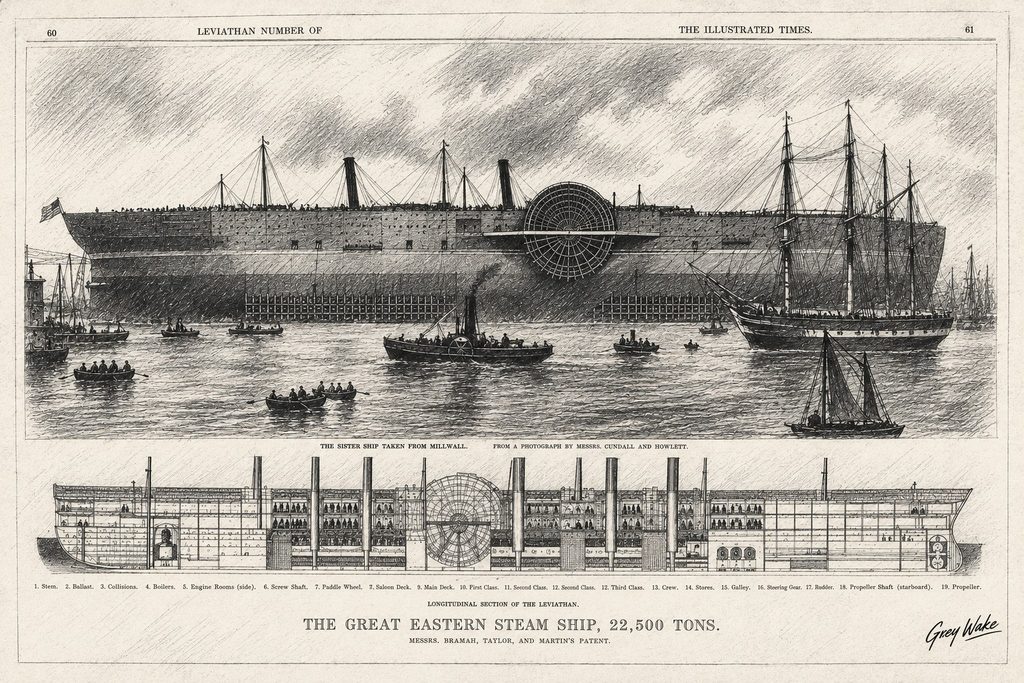
On November 3, 1857, Isambard Kingdom Brunel stood on the launch platform at John Scott Russell’s yard in Millwall, London, watching workers attach chains to his “Great Babe.” The vessel towering above him stretched 692 feet — longer than any ship yet built. Her scale dwarfed the largest vessels then afloat. Few existing docks and port facilities were equipped to handle a ship of her dimensions. No existing commercial market was clearly capable of absorbing her intended scale. And yet, here she was, poised to become either Britain’s greatest industrial triumph or its most expensive catastrophe.
Brunel had designed the SS Great Eastern to solve a persistent problem in maritime commerce: coal consumption. Existing vessels burned fuel so voraciously that captains had to stop at coaling stations — at Gibraltar, Madeira, St. Helena, Singapore, and other ports across three continents. These stops added time, cost and dependence on a network of overseas supply points. Brunel’s vision was radical: build a ship large enough to carry sufficient coal to steam from Britain to Australia and back without refueling. The commercial logic was to reduce dependence on intermediate coaling stops and exploit economies of scale over very long routes.
The engineering was revolutionary. The challenge was that the market structure of 1860 could not absorb the scale Brunel had designed for.
The obsession that consumed a genius
By the mid-1850s, Brunel was Britain’s most celebrated engineer. His Great Western Railway had revolutionized transport between London and Bristol. His steamships — the SS Great Western and the SS Great Britain — had pioneered long-distance steam navigation and demonstrated the potential of iron construction and steam propulsion for ocean-going ships. He had spent his life pushing against limits that others accepted as fixed.
But he had become obsessed with a single problem that no amount of conventional engineering seemed to solve: the coal bottleneck.
Every steamship burned fuel voraciously. A vessel crossing the Atlantic at full power consumed coal at rates that made profitability difficult. Captains had to stop at coaling stations across three continents to refuel. Every stop added time and operating complexity. The coal itself was dead weight — cargo space devoted to fuel rather than paying passengers or cargo. A ship that could carry enough coal for a 22,000-mile voyage would liberate long-distance commerce from the coaling-station network.
Brunel’s insight was radical: if a ship was large enough to carry truly massive quantities of coal, she could eliminate these intermediate stops. She could sail from Britain to Australia and back without refueling. That would mean real competitive advantage. That would mean freedom from the coaling-station system that constrained long-distance steamship operations.
But how large would such a ship need to be? And what would construction cost?
In 1853, he partnered with John Scott Russell, a Scottish naval architect, shipbuilder and influential exponent of wave-line theory. Russell brought formidable expertise in hull form and ship construction to a concept whose fundamental scale and propulsion philosophy Brunel had already begun to define. Russell had spent years developing and promoting hydrodynamic principles — curved hull shapes designed to move through water with minimal resistance. Brunel saw in Russell a collaborator whose theoretical work could inform his ambitious calculations. Together they began drawing specifications that would test the limits of iron construction, steam power, and human ambition.
The ship would combine paddle wheels — connected to dedicated steam engines for maneuverability — with a screw propeller for open-ocean efficiency. And she would carry six masts for sail. Screw propulsion was still sufficiently new that Brunel doubted whether a single screw could transmit enough power to move a ship of this scale. He therefore combined screw propulsion with paddle wheels and auxiliary sail to distribute operational risk. This hybrid system reflected both engineering uncertainty and practical caution.
The Eastern Steam Navigation Company provided funding. The business case rested on the belief that unprecedented carrying capacity and long-range operation could make passenger, troop and cargo traffic profitable on distant routes. The ship would carry 4,000 passengers — then an enormous figure for any single vessel. The company assumed that this scale would justify the extraordinary construction costs.
Brunel’s work for the Australian Mail Company helped crystallize the idea. In 1851 he had already urged its directors to consider ships of 5,000–6,000 tons for the Australian service; some directors balked at the scale. The exercise pushed him toward an even more radical concept — a single enormous vessel capable of sustaining the entire route. The Australian Mail Company itself did not pursue the project, but the experience had shaped Brunel’s conviction that unprecedented scale was the only viable solution to the distance-and-fuel problem. The Eastern Steam Navigation Company would provide the institutional vehicle for the far more radical project that followed.
Construction began in May 1854 at Millwall Iron Works. Workers confronted dimensions they had never attempted. Rivetters deployed new techniques. Girders arrived that required teams of men to position. A legend later grew around the construction — that a riveter and his young assistant had vanished and been sealed inside the double hull. Never securely established as fact, the story became part of the folklore surrounding a project whose scale already seemed extraordinary to contemporaries.

The launch that broke the will
By November 1857, the ship’s enormous mass terrified as much as it inspired. She was too long for a conventional stern-first launch into the Thames at Millwall. The sideways-launch system was itself an innovation — no one had attempted to slide a vessel this enormous into the water from the side. Hydraulic rams and control chains would manage the descent.
On November 3, thousands gathered. The press had built anticipation for weeks. Unbeknownst to Brunel, around 3,000 tickets had been sold for the spectacle.
The hydraulic system engaged. The ship moved only about four feet before the launch-control machinery ran into serious trouble. One worker was killed and several others injured. Emergency procedures halted further movement. The vessel remained partially grounded. Brunel had faced an acute public embarrassment.
The launch had failed. The crowds dispersed. Work resumed into December, then January. The checking mechanisms were redesigned. Workers labored through winter. Brunel drove repeated attempts toward resolution.
On January 31, 1858, aided by spring tides and after nearly three months of repeated attempts, the Great Eastern finally floated.
The trials and the stroke
Nineteen months later, in September 1859, the Great Eastern was being prepared for final trials. Brunel was fifty-three years old, his body exhausted by years of relentless engineering work. He attended inspections personally, walking the decks of his achievement.
On September 5, 1859, while aboard the ship, Brunel suffered a severe stroke. He collapsed and was rushed home, gravely ill and paralyzed. He lay bedridden.
Four days later, on September 9, while Brunel lay at home, the Great Eastern departed the Thames for her trial voyage. While passing the south coast near Hastings, a heater associated with the paddle-engine boiler system exploded after dangerous pressure built up in a system lacking adequate safety-valve protection. The explosion killed six firemen. It tore through the grand saloon, twisted iron bulkheads, and damaged a section of the funnel.
The coincidence later proved irresistible to the ship’s mythology: Brunel was stricken days before a lethal explosion aboard his greatest project.
On September 15, 1859, ten days after his stroke, Isambard Kingdom Brunel died at fifty-three. He had survived long enough to learn of the explosion aboard the Great Eastern. The public narrative wrote itself: the ship had destroyed its maker. Engineering hubris punished by forces beyond human control. It was a perfect story. It was also fundamentally wrong.

A ship too vast for markets that did not yet exist
By 1860, the Great Eastern’s economic model was in crisis.
Her first transatlantic commercial voyage carried only 35 fare-paying passengers plus eight company guests — a humiliating void in a ship designed for 4,000. Few existing port facilities could accommodate her unprecedented dimensions. Passenger traffic repeatedly fell far short of the ship’s capacity. Competitors built smaller vessels whose capacity aligned with actual market demand and existing infrastructure. Within months of beginning commercial service, it was clear the passenger business would never generate the returns that Brunel’s scale had promised.
Brunel had identified a genuine long-distance/fuel-autonomy need. But he had answered it with a scale that Victorian maritime markets could not yet profitably absorb. The market for 4,000-passenger liners would eventually exist, but not in 1860. The demand would come, but not in time for the Great Eastern.
By the time the Suez Canal opened in 1869, the Great Eastern’s transformation was already complete. She had already successfully laid the 1866 transatlantic cable and was engaged in subsequent cable operations. The Suez opening was economically irrelevant to her future — she had already found her purpose in submarine telegraph work. The canal would have weakened the logic of a pure passenger liner optimized for long Cape voyages, but it came too late to affect the Great Eastern’s trajectory.
Yet something remarkable happened next.
The resurrection through infrastructure
In 1864, the Great Eastern was chartered to the Telegraph Construction and Maintenance Company for submarine cable-laying work. Ownership and control had passed to Daniel Gooch and other investors organized as the Great Eastern Steamship Company. Gooch, who had worked with Brunel on railway projects, arranged the ship’s charter to Telcon for cable operations.
Telegraph cables required extraordinary deck space and operational capacity. The ship’s coal capacity, which had seemed overengineered for passengers, was now a genuine operational advantage. Her powerful engines could maintain the steady speeds necessary for laying cable while managing enormous mechanical stresses. Most crucially, three massive iron cable tanks built into her converted hold could accommodate the vast lengths of cable required — approximately 2,300 miles per expedition, weighing 4,100 tons. The tanks contained water and carefully coiled cable. Beyond the cable weight, the tanks themselves held about 1,198 tons of water — a total tank load of roughly 5,300 tons. This extraordinary holding capacity was exactly what telegraph cable-laying required.
The 1865 expedition was a technological ordeal. For the first time, the ship demonstrated her value by attempting to carry a full transatlantic cable run in a single voyage. The operation required adapting existing cable-laying techniques to unprecedented cable length, weight and shipboard machinery. Telegraph engineers had to coordinate payout mechanisms, monitor electrical signals, and manage machinery under stresses never before attempted on this scale.
On August 2, 1865, with the Great Eastern still about 600 miles — and roughly two days — from Heart’s Content, Newfoundland, the cable parted. The broken end sank into water roughly 2½ miles deep. Repeated grappling attempts failed. The expedition returned to Ireland in defeat.
Yet failure did not end the vision. In summer 1866, another expedition departed. This time, with hard-won experience from the previous attempt, the Great Eastern succeeded. On July 27, 1866, the ship entered Heart’s Content, Newfoundland. The cable from Valentia Island, Ireland, was secure. A durable transatlantic telegraph connection was finally in operation.
Later that same year, using grappling operations, the Great Eastern crew located the sunken 1865 cable on the seabed, raised it, and completed that connection as well. By September 1866, two separate transatlantic telegraph cables linked the continents — both laid by the same improbable ship. The Great Eastern had succeeded in a task for which her extraordinary carrying capacity made her uniquely valuable.
She later worked on French Atlantic and eastern cable projects, including links in the route between Bombay, Aden and Suez. From 1865 through the early 1870s, she became one of the pivotal vessels of the expanding global submarine telegraph network.
Brunel had designed for one commercial purpose: passenger transport on long routes with minimal refueling stops. Telegraph engineers recognized that his oversized ship was perfectly adapted for a radically different task — laying the cables that connected continents at the speed of electricity. The vessel that failed utterly as a passenger liner became crucial for infrastructure that Brunel had never envisioned.
The Great Eastern did not wait decades for redemption. Between her failed commercial debut in 1860 and her first successful cable lay in 1866 — just six years — her massive holds were repurposed from a commercial liability into exactly what submarine telegraph infrastructure required.

The decline into mythology
The cable-laying career peaked in the early 1870s. New purpose-built cable ships gradually replaced the Great Eastern. After the cable-laying phase ended in the early 1870s, the Great Eastern spent roughly twelve years largely laid up at Milford Haven in Wales — idle, expensive, increasingly irrelevant.
In 1886, the ship entered a new life as a floating exhibition and advertising platform. Lewis’s Department Store, the Liverpool retail giant, used her as a spectacular floating advertisement, and the vessel subsequently appeared at several British and Irish ports. Crowds paid to see the still-famous giant ship, now transformed into a floating commercial spectacle.
By 1887, even this exhibition purpose had exhausted itself. The ship was sold, and by 1888 she had been acquired for breaking. Dismantling began at New Ferry on the River Mersey in 1889. Around 200 men labored for nearly two years, systematically taking her apart. The double hull that had made her revolutionary to build made her agonizing to demolish.
The story of skeletons supposedly found inside the double hull returned during dismantling — the riveter and his helper sealed inside since 1854. No contemporary dismantling records confirm this. The legend persisted through later retellings.
By 1890 the hull had disappeared, leaving only salvaged artefacts, documentation and memory.

What survived: the artifacts and the funnel
The Great Eastern exists today only as fragments.
No hull survives. No working engines remain. The ship was too large, too expensive, too historically exhausted to preserve. Breaking her into scrap iron was simpler than maintaining her. Industrial economics required that she be dismantled and recycled — which is exactly what happened.
But artifacts persisted.
The Royal Museums Greenwich preserves an extensive Great Eastern collection including models, prints, technical records, cable-related manuscripts and surviving tableware. A 1:12 scale model of the paddle-wheel engines survives in the Science Museum London (on display in Making the Modern World), showing the extraordinary mechanical complexity of systems that had never been attempted at such scale.
Most significantly, the funnel damaged in the 1859 explosion still exists. It is displayed in the Being Brunel museum at Brunel’s SS Great Britain in Bristol, operated by the SS Great Britain Trust. The surviving funnel is a rare surviving physical witness to the 1859 explosion aboard the Great Eastern.
The Brunel Institute in Bristol holds extensive Great Eastern material including engineering drawings, correspondence and specifications related to the ship’s construction, trials, and cable operations. The University of Bristol Archives maintain additional primary materials, including experimental data and technical documentation from Brunel’s work on the design.
The SS Great Britain, Brunel’s second great steamship, survives fully restored as a floating museum in Bristol. When visitors walk the decks of the Great Britain and stand in her engine rooms, they grasp something of Brunel’s scale and ambition. But the Great Britain is smaller than the Great Eastern — which means even standing inside one of the world’s greatest surviving Victorian ships leaves people wanting to understand how much larger, how much more impossible the Great Eastern truly was. The Great Eastern herself offered no such mercy. Roughly thirty-two years separated her launch from the disappearance of her hull.
The lesson about asset repurposing
The Great Eastern revealed something more subtle than “premature innovation.” She demonstrated the power of technological repurposing: an asset optimized for one commercial application can prove essential for a radically different system that emerges later.
Brunel designed for passenger transport. Telegraph cable-laying was not part of his vision. Yet within six years of her commercial debut, the same massive holds that were a burden for Atlantic travel became exactly what the submarine telegraph network required. The Great Eastern did not wait fifty years for vindication. It found purpose almost immediately in a different system.
The ship’s real tragedy was not that she was born too early. It was that her designers failed to anticipate where market demand would actually emerge. What the Great Eastern proved was that revolutionary scale can become valuable when matched to the right operational task. In her case, that task appeared not after decades of waiting, but within years, in a form Brunel had never imagined.
She was not cursed. She was a magnificent platform that found its true purpose.
Ship identity
| Specification | Details |
|---|---|
| Final name in service | Great Eastern |
| Name at attempted launch | Leviathan |
| Laid down | May 1, 1854 |
| Launched | January 31, 1858 |
| Completed | 1859 |
| Builder | John Scott Russell & Co., Millwall |
| Designer | Isambard Kingdom Brunel |
| Tonnage | 18,915 tons |
| Dimensions | 692 ft × 83 ft |
| Passenger capacity | 4,000 (designed) |
| Propulsion | Paddle wheels, screw propeller, auxiliary sail |
| Port of registry | Liverpool |
| Career span | 1859–1888 (active/operational career) |
| Fate | Sold for breaking; dismantled 1889–1890 |
Career and operational timeline
| Period | Status | Notes |
|---|---|---|
| May 1854–Jan 1858 | Under construction | Built by John Scott Russell & Co. under Brunel’s design for the Eastern Steam Navigation Company; multiple launch attempts over three months; ship floated 31 January 1858 |
| Feb 1858–Jun 1860 | Fitting out and trials | Two and a half years to complete fitting out; trial voyages conducted in 1859; on 5 September 1859 Brunel suffered a stroke aboard the ship; on 9 September 1859 an explosion off Hastings killed six firemen; Brunel died 15 September 1859; first commercial transatlantic voyage departed June 1860 |
| 1860–1863 | Passenger liner service | Main commercial passenger operation; maiden transatlantic voyage June 1860; regular passenger service effectively ended by 1863; ship sold in 1864 for conversion to cable work |
| 1864–1865 | Conversion to cable ship | Acquired by investors including Daniel Gooch and prepared for submarine cable-laying operations; converted to carry the Atlantic telegraph cable |
| 1865–1872 | Cable-laying operations | 1865 Atlantic cable expedition failed; 1866 Atlantic cable succeeded, reaching Heart’s Content on 27 July; the lost 1865 cable was subsequently recovered and completed; further cable operations followed, including Atlantic and Bombay–Aden links |
| 1872–1886 | Largely laid up | Spent roughly twelve years largely laid up at Milford Haven after the principal cable-laying phase |
| 1886–1887 | Floating exhibition / advertising | Used as a floating exhibition and advertising platform, including for Lewis’s Department Store; appeared at Liverpool, Dublin and the Clyde |
| 1887–1888 | Sold for breaking | Offered at auction in October 1887 and subsequently acquired by Henry Bath & Sons; moved to New Ferry on the River Mersey in 1888 for dismantling |
| 1889–1890 | Dismantled | Breaking began at New Ferry in 1889; approximately 200 men worked on dismantling the exceptionally difficult double hull, with the process completed by 1890 |
What Brunel’s curse revealed
Infrastructure and markets lag behind engineering innovation. Brunel designed for a ship roughly five times the tonnage of her largest predecessors. Existing docks and port infrastructure could not easily accommodate her. But this was not a permanent barrier — infrastructure matured when demand justified it.
Asset value depends on operational context, not just design excellence. The Great Eastern’s engineering was magnificent. But the market for 4,000-passenger ships in 1860 did not exist. Genius design cannot create demand ahead of its time. Yet the same ship became invaluable when submarine cable-laying emerged as a need.
Repurposing can recover value faster than waiting for the original market. Her passenger operation had effectively ended by 1863. But telegraph engineers immediately recognized that her exceptional holds — oversized for passenger comfort — were exactly what cable-laying required. Within three years of passenger failure, the Great Eastern had successfully laid a transatlantic telegraph cable.
Myth persists because technical explanation is harder than supernatural narrative. The legend of the sealed riveter, the curse following the ship, Brunel’s death as cosmic punishment — these stories circulated widely. In later retellings, technical and commercial failure was increasingly compressed into a simpler narrative of curse, hubris and death.
That is a more interesting story than any curse — and far more relevant to understanding how technological systems actually evolve.